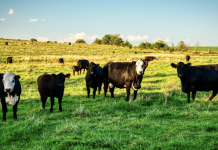
Producing beef is resource-intensive, but new research at Oklahoma State University (OSU) aims to change that. A team led by Dr. Mary Foltz, with graduate student Allie Thomas, is studying whether grazing cattle on wheat–sorghum–fallow rotations can lower the carbon and water footprint of beef production.
The project, funded by the U.S. Department of Agriculture, uses life cycle modeling to measure greenhouse gas emissions and water use across the entire system—from fertilizer production to cattle growth and transportation. Results will be compared with conventional feedlots.
“Grazing is considered more ethical and potentially more sustainable since it avoids some transportation and feed processing,” Foltz explained.
For producers, the study could provide practical tools to evaluate both sustainability and profitability. The team also plans to deliver a generalized model that could be applied beyond Kansas to other dryland regions.
Thomas, who is collecting greenhouse gas samples as part of her thesis, says the project builds on her environmental engineering training and will give her an edge as she enters the industry.
By delivering data directly to producers, the researchers hope to support industry shifts toward more sustainable beef production while meeting growing consumer demand for grass-fed and pasture-raised products.